Opportunities Abroad

UGALAPAGOS BIOLOGY

‌UGalapagos Biology is a unique program that couples small, intensive courses with a deep immersion in a foreign culture.  It surpasses programs offered by others that are usually confined to cruise ships with only episodic contact with island flora, fauna and people.  In UGalapagos Biology, you live with families and engage in community service activities defined by the community. The UGalapagos Biology program in the Spring semester is unique from other Galapagos programs in incorporating a 5-day trip into the heart of the Amazon and four weeks in the highlands of Ecuador, providing students the opportunity to compare the flora, fauna and cultures of  continents and islands. Further, our partnership with a local university allows for direct research experiences with faculty who do research in Galapagos.

For more information, contact Dr. Neil Rosser or Dr. Juan Quimbayo, Co-Directors of the UGalapagos Biology program.


STUDY ABROAD

There are many opportunities for students to participate in Study Abroad programs for the summer, spring and fall semesters:

University of Miami Study Abroad Site

Accordion Group

Open All Tabs
  • Why UGalapagosBio?

    The UGalapagosBio program, offered by the Biology Department, focuses on unique environments:  the Amazon Tropical Forest, the Andes, and particularly the Galapagos islands.  In the Galapagos, the flora, fauna and people are emblematic of biological and social processes that act universally, but are most evident in this harsh environment that has molded living beings.  The people are subject to third-world pressures and politics and the demands of an environment that has limited resources, most of which need to be imported.  Students live with families, both in Quito and in the Galapagos.  The islands’ severe natural selection pressures have produced emblematic species that are both intriguing and accessible.  On the islands, the reptiles and birds ignore humans:  You can stand as close as six feet away from them and watch as they live their lives, feeding, mating, raising their young.  You can easily discriminate and study ecosystems, from a mangrove fringe to a low arid zone of desert-like plants, an intermediate zone of arid forests and at higher elevations humid zones of tropical grasslands and forests.  This accessibility enhances learning, so that lectures merge directly into field work and back to analysis, assessment and writing.  The Galapagos is an open laboratory for critical thinking.

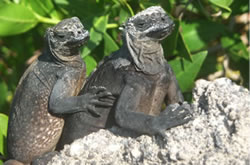
    The Biology department offers a full term of UGalapagosBio courses that are taught sequentially and focus on terrestrial ecosystems.  It is hosted by  The University of San Francisco Quito, Galapagos Extension which has campuses in Quito and on the Galapagos Island of San Cristobal.  The classes, while demanding, leave students time for socializing, surfing and snorkeling with seals, marine iguanas, diving birds and penguins.

  • Travel

    Are there opportunities for visiting other Galapagos sites? |
    Yes, during the week break, all the classes (including students from other Universities) will be taken to Santa Cruz and will be lodged in Puerto Ayora (the largest Galapagos city) for a few days.  You will meet with researchers from the famous Charles Darwin Station, hear talks from NGOs that are running successful conservation programs, visit the wonderful reptiles in the station (including a new exhibit on Lonesome George, thought to be the last of his species).  You will visit emblematic environments such as the humid highlands where you can see tortoises, Scalesia forests (imagine a forest of gigantic sunflowers!) and lava tunnels. During this trip, the class will visit other islands, possibly Bartolome and likely Isla Isabela, where if you walk along the beach you will be gauranteed to see many marine iguanas of all sizes, frigate birds, penguins, boobies, whimbrels, etc... Be sure to bring your pocket guide to Galapagos plants and animals!

Top